John Randolph Winslow (1938–2024) was an American painter whose work bridged abstraction and lived experience through a sustained investigation of space, structure, and human consciousness. Born in Washington, D.C., and shaped by an environment rich in artistic and intellectual exchange, Winslow developed a practice grounded in discipline, inquiry, and material presence.
Over a career spanning more than five decades, he produced hundreds of paintings—what he called “Wonderments”—that explore the interplay of memory, architecture, and perception. In parallel with his studio practice, Winslow taught for more than thirty years, influencing generations of artists through a rigorous and deeply thoughtful approach to artmaking. His legacy lives in both his work and the many students, collectors, and institutions shaped by his vision.
Winslow was born in 1938 in Washington, D.C., into a family shaped by art, architecture, and public life. His mother, Marcella Comès, was a trained portrait painter, and his maternal grandfather was an architect of Catholic churches. Their home became a cultural salon, frequented by artists, writers, and intellectuals. A defining early influence was the imaginative world he created with his sister Mary, inventing a private language—“Massarel”—through which they expressed shared ideas and inner worlds.
This early act of constructing meaning through language and imagination foreshadowed Winslow’s lifelong artistic inquiry. The loss of his father, a U.S. Army Colonel who died during World War II, profoundly shaped the emotional and intellectual landscape of his upbringing. Raised by a working artist, Winslow absorbed both the discipline of craft and the resilience required to sustain a creative life.
Winslow’s formal training began at Phillips Academy Andover and continued at Princeton University, where he studied architecture. He later pursued painting at the Yale School of Art, where he studied under Josef Albers, whose emphasis on structure, perception, and disciplined experimentation had a lasting impact on his work. He received his MFA from Yale in 1963.
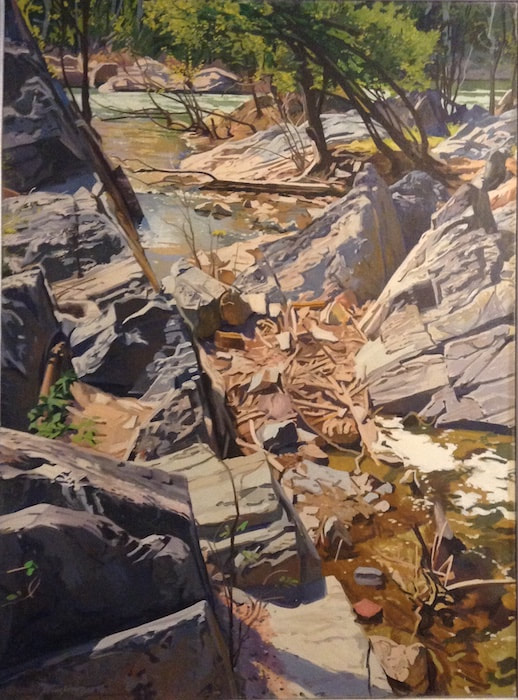
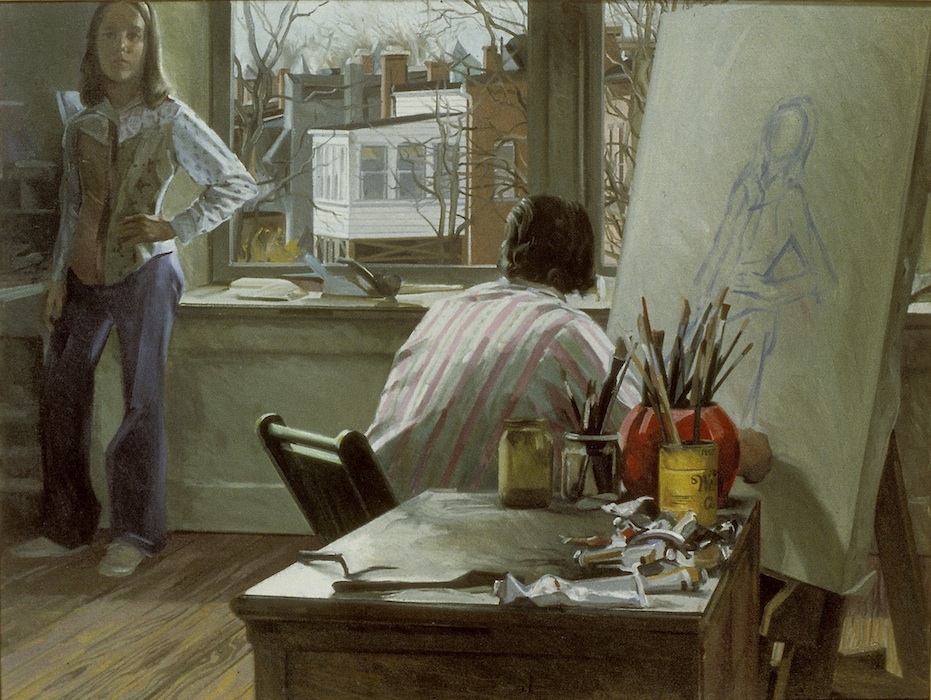
Throughout his career, Winslow pursued a singular artistic problem: how to reconcile the spatial depth of realism with the formal rigor of abstraction. His paintings evolved into complex compositions where architectural space, human figures, and abstract forms coexist. His work often integrates fragments of art history, memory, and observation—layered within shifting spatial planes. Figures inhabit environments that feel both constructed and fluid, where time collapses and perception becomes active. Winslow described these works as “Wonderments,” visual explorations of how the mind processes reality, memory, and imagination simultaneously.
An important turning point came during travels in Italy, where his landscapes began to absorb abstraction more fully. Over time, he achieved a synthesis in which realism and abstraction no longer competed but operated as a unified language.
In 1969, Winslow joined the faculty at The Catholic University of America in Washington, D.C., where he held a dual role teaching both architectural rendering and studio art. For more than three decades, he balanced teaching with an active studio practice. Known as a demanding and deeply engaged educator, Winslow emphasized process, discipline, and critical thinking.
He challenged students to confront both simplicity and complexity, encouraging them to develop a personal visual language rooted in inquiry rather than style. His influence extended well beyond the classroom. Students and colleagues alike recognized his commitment to art as an intellectual and philosophical pursuit, one that required sustained attention and rigor.
In the 1980s, Winslow entered a period of intense productivity, refining the visual language that would define his mature work. After returning to his childhood home in Georgetown and converting a garage into a studio, he devoted himself fully to painting. In the 1990s, his marriage to poet and scholar Rosemary Winslow marked the beginning of a deeply collaborative intellectual partnership.
Together, they cultivated a creative life centered on the exploration of “deep beauty,” with their shared practice bridging painting and poetry. Winslow’s later works are characterized by a confident synthesis of abstraction and representation. Critics and collectors noted his ability to transform ordinary scenes into complex, luminous compositions. His paintings present layered realities in which figures, structures, and memory coexist—offering viewers an active role in interpreting space and meaning.
John Winslow passed away on September 1, 2024, at the age of 86. He leaves behind a significant body of work, including more than 185+ digitized paintings, as well as writings, recordings, and archival materials documenting his process and philosophy. His legacy is both artistic and pedagogical. His paintings continue to engage viewers in questions about perception, time, and human experience, while his teaching lives on through the many artists he mentored.
The Wonderments initiative seeks to preserve and expand this legacy through a comprehensive archive, a feature-length documentary, and educational programming for institutions and audiences worldwide. This effort positions Winslow not only as an artist of his time but as a continuing voice in contemporary discussions about creativity, authorship, and the role of art in an increasingly technological world.
At its core, Winslow’s work affirms a simple but enduring idea: that art is a human act of wonder, one that invites us to see, to question, and to imagine more deeply.

_OilCanvas_30x40.jpg)